![SETsquared Bath Innovation Centre [University of Bath]](http://images.squarespace-cdn.com/content/v1/59ad4c7ef14aa16da6b98425/1543483421246-WGI6RKDJ139AWS7J59TB/ss-bath.png)
Member Spotlight: Forceteck, From the Lab to the Touchline
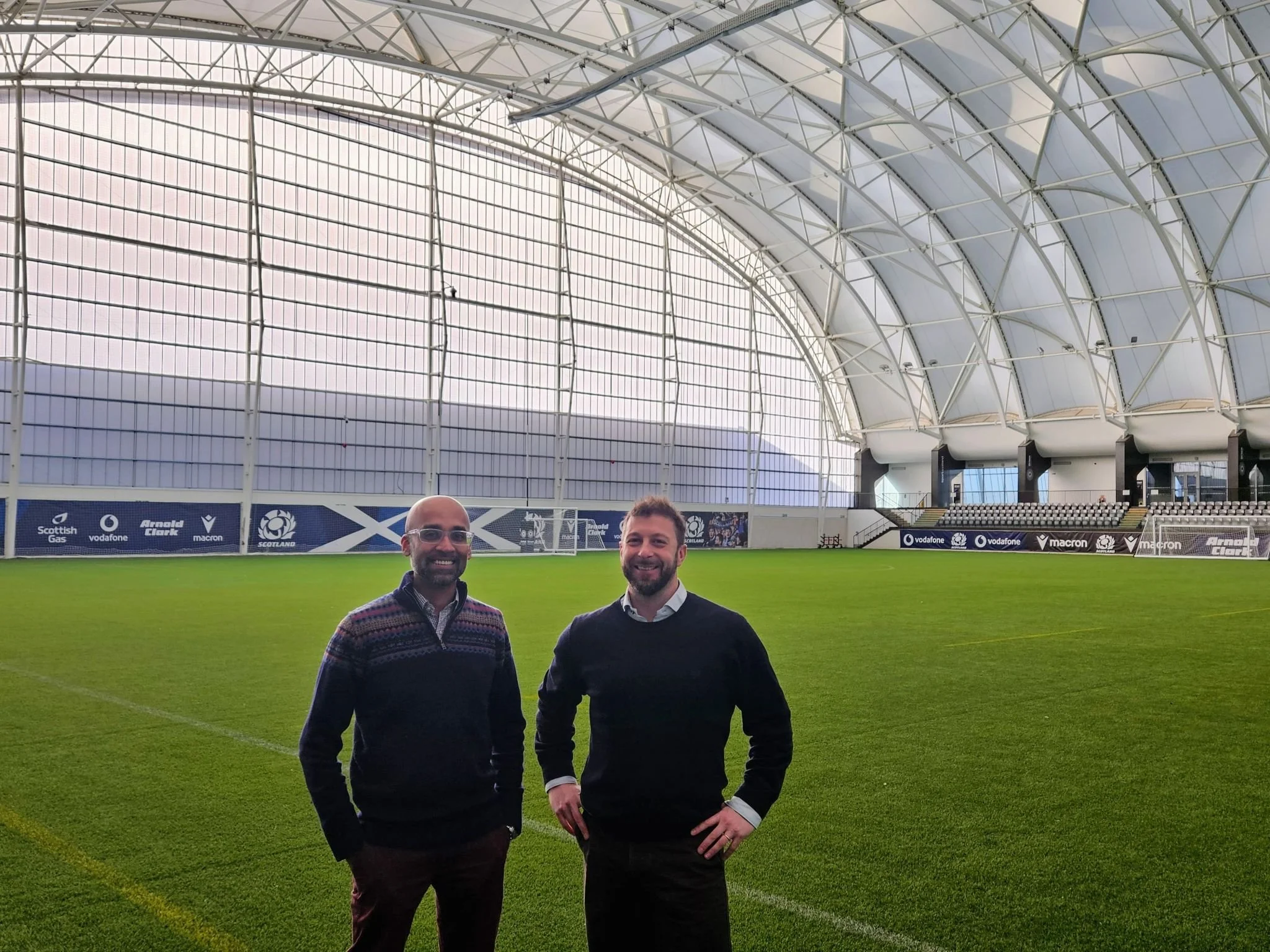
In elite sport, it’s not enough to know how an athlete performed. The bigger question is why they performed in that way and thet forces their body endured to do it - and what that means for performance, injury, and recovery.
That level of insight has traditionally belonged to the lab: force plates, motion capture systems, and weeks of post-processing. Forceteck is making it possible to get the same quality of data from standard video - fast, accurate, and explainable.
Co-founded by biomechanical engineer Dr. Dario Cazzola and technology entrepreneur Roy Shubhabrata, Forceteck uses computer vision and physics-informed machine learning to estimate forces acting on the body in real-world sporting environments - including joint loads, collisions, and ground reaction forces.
"Players aren't available either because they're injured or because they are not fit enough to play," says Dario. “We provide them with a technology that could be used on the pitch, providing lab-grade performance data in a very fast way.”
Forceteck’s system starts by tracking joint positions using single or multiple cameras. From there, it applies AI models trained on elite movement datasets to estimate force. The models are built with physical and physiological principles embedded - producing outputs that are not only fast but accurate and explainable.
“Most machine learning approaches are black boxes,” says Dario. “What we do, we make it transparent - and explainable - which is very important in injury prevention and performance."
The original research behind Forceteck came from Dario’s academic work. But it was Roy who spotted the opportunity to take it further - and pushed it into a real-world setting.
"When Dario told me about his research, I knew straight away that there was a commercial angle,” he says. “I submitted an application at a pitching competition in the Southwest without telling him. And we ended up winning.”
From that point, the platform evolved rapidly - helped in part by Forceteck’s membership in the SETsquared Bath Innovation Centre, which provided mentorship, IP guidance, and early commercial validation.
"I was helped since the beginning by SETsquared, and SETsquared provided me with different mentors,” says Dario.
The support also helped clarify a key path that many researchers overlook: owning their IP and building from it.
Today, Forceteck’s solution is being used by professional teams in multiple sports and they have also worked with the European Space Agency, applying the same system to analyse forces on astronauts in microgravity.
"They want to know what will happen to astronauts and forces on their body in different gravitational settings," says Roy.
Forceteck is giving teams access to the kind of lab-grade biomechanical data that used to take weeks - now in real time, on the field, and ready to use. It’s built for practitioners who don’t need more data, just better answers.